OEM vs aftermarket engine splash shields is a common consideration when you need to replace a damaged, cracked, or missing engine splash shield. When an engine splash shield needs to be replaced, one of the first decisions you’ll face is whether to buy an OEM engine splash shield or an aftermarket replacement.
At first glance, the choice seems simple: OEM parts come from the vehicle manufacturer, while aftermarket parts are produced by other companies. But the cheaper aftermarket option isn’t automatically a bad choice, and the more expensive OEM part isn’t automatically the right choice for every vehicle.
The important questions are:
- Will the replacement fit your vehicle correctly?
- Is the material durable enough for normal road conditions?
- Does it provide adequate protection from water, dirt, mud, and road debris?
- Does it include the required mounting points or hardware?
- Is the price difference justified for your particular vehicle?
This guide explains the differences between OEM and aftermarket engine splash shields so you can make an informed purchase.
INTERNAL LINK: Engine Splash Shield Category
What Is an Engine Splash Shield?
An engine splash shield—also called an engine under cover, lower engine cover, under-engine cover, or skid-style splash panel depending on the vehicle—is a protective panel installed underneath the engine compartment.
Its main purpose is to help shield the underside of the engine and surrounding components from:
- Water
- Road spray
- Mud
- Dirt
- Salt and other road contaminants
- Small stones and debris
- Excessive airflow underneath the vehicle
The exact design varies considerably between vehicles. Some vehicles use a relatively small plastic panel, while others have a larger underbody cover extending across several areas underneath the engine compartment.
A damaged or missing splash shield can expose components underneath the vehicle to significantly more road contamination.
If your current shield is dragging, cracked, hanging down, or missing mounting hardware, replacement is usually preferable to continuing to drive with a loose panel.
INTERNAL LINK: Engine Splash Shield Replacement Guide
OEM vs Aftermarket: What’s the Difference?
The fundamental difference is who manufactures the part and how it is sold.
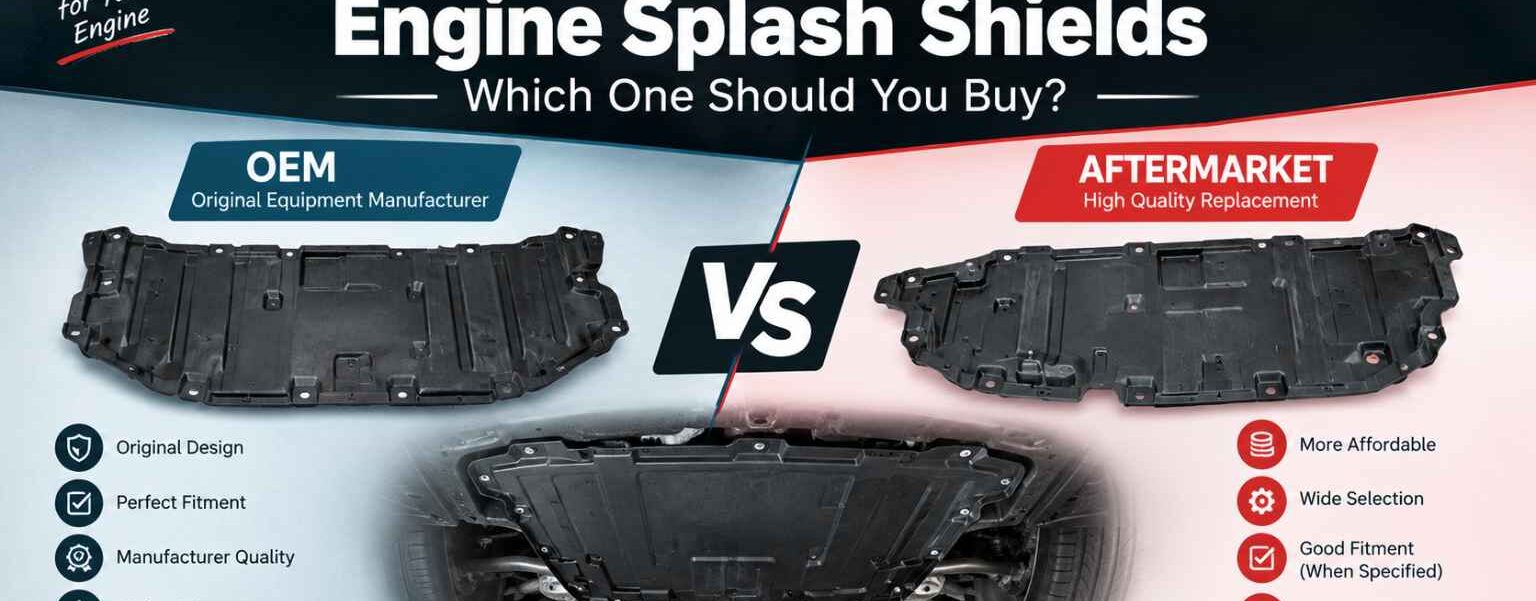
OEM Engine Splash Shield
OEM stands for Original Equipment Manufacturer.
An OEM replacement is generally produced for the vehicle manufacturer’s original equipment supply chain or sold under the vehicle manufacturer’s branding. It is intended to match the original design and specifications for a particular vehicle application.
For example, an OEM splash shield for a specific Toyota model and model year is designed around that vehicle’s original mounting locations and underbody configuration.
Aftermarket Engine Splash Shield
An aftermarket splash shield is produced by a company other than the vehicle manufacturer and sold as a replacement part.
Aftermarket manufacturers may reproduce the original design, improve certain aspects of it, or manufacture a compatible alternative.
However, aftermarket quality varies. That’s why you shouldn’t judge an aftermarket part solely by its price.
The key question is not simply:
“Is it OEM or aftermarket?”
A better question is:
“Is this replacement part correctly designed and specified for my exact vehicle?”
OEM Engine Splash Shields: Advantages and Disadvantages
OEM parts have some obvious advantages, but they also come with trade-offs.
Advantages of OEM Splash Shields
Designed for the Original Vehicle Application
OEM parts are intended for a specific vehicle application. This can make compatibility easier to verify when you use the correct OEM part number.
The original part was designed around the vehicle’s factory mounting points, surrounding components, and underbody layout.
Familiar Original Design
If your original splash shield worked properly before it was damaged, an OEM replacement generally follows the original design.
For owners who simply want to restore the vehicle to its factory configuration, this can be attractive.
Easier Part-Number Matching
OEM parts can often be identified using the manufacturer’s part number.
If you already know the correct OEM part number, it can provide a useful reference when comparing replacement options.
Useful for Certain Vehicles
For some vehicles, particularly newer or less common models, an OEM part may be easier to justify if there are limited aftermarket alternatives or if fitment is particularly complex.
Disadvantages of OEM Splash Shields
Higher Purchase Price
The biggest disadvantage is often cost.
An OEM splash shield can cost considerably more than an aftermarket replacement for the same vehicle application.
That price difference may matter when the splash shield is a relatively simple replacement panel.
Dealer or Manufacturer Pricing
OEM parts are frequently sold through dealerships or manufacturer parts channels, where pricing can include additional distribution and branding costs.
Not Always Necessary
A higher price doesn’t automatically mean the OEM shield will provide a meaningful improvement for every application.
If a properly manufactured aftermarket replacement matches the vehicle’s required fitment and mounting points, it may perform the intended protective function without the OEM price premium.
Aftermarket Engine Splash Shields: Advantages and Disadvantages
Aftermarket replacement parts are widely used because they can provide a more affordable alternative to OEM components.
Advantages of Aftermarket Splash Shields
Lower Cost
Price is one of the biggest reasons customers choose aftermarket parts.
For an older vehicle or a vehicle that needs several repairs, reducing the cost of individual replacement parts can make the repair considerably more affordable.
Wide Selection
The aftermarket contains replacement splash shields for a large range of:
- Makes
- Models
- Model years
- Engine configurations
- Body styles
- Front and rear underbody locations
This can make it easier to find a replacement when the original part is damaged.
Good Fitment Is Available
A properly manufactured aftermarket splash shield can be designed around the same vehicle application and mounting locations as the original component.
The important part is selecting the correct application rather than assuming that every aftermarket part is interchangeable.
Practical for Everyday Repairs
For many everyday vehicles, the purpose of the splash shield is relatively straightforward: provide underbody protection and remain securely mounted during normal driving.
A correctly specified aftermarket replacement can be a practical solution for this type of repair.
Disadvantages of Aftermarket Splash Shields
Quality Can Vary
“Aftermarket” is a broad category.
Different manufacturers can use different materials, manufacturing processes, thicknesses, reinforcement designs, and quality-control standards.
That means two aftermarket splash shields for the same vehicle may not be identical in quality.
Fitment Must Be Checked Carefully
A part that looks similar in a photograph isn’t necessarily compatible with your vehicle.
Small differences in:
- Mounting holes
- Clips
- Fasteners
- Shape
- Dimensions
- Engine configuration
- Model year
can make a replacement unsuitable.
Hardware May Not Always Be Included
Some replacement splash shields are sold as the panel only.
Others may include clips, screws, or mounting hardware.
Always check the product listing carefully before ordering.
OEM vs Aftermarket Engine Splash Shield Comparison
| Factor | OEM | Aftermarket |
|---|---|---|
| Vehicle-specific design | Yes | Usually, when correctly specified |
| Factory branding | Usually | No |
| Price | Usually higher | Often lower |
| Availability | Depends on vehicle | Often broad |
| Fitment | Designed for application | Varies by manufacturer |
| Material quality | Original specification | Varies |
| Part selection | Manufacturer-specific | Multiple manufacturers |
| Best for | Factory restoration | Cost-conscious replacement |
| Compatibility check | Part number/VIN/application | Exact fitment/application is critical |
The table shows why there isn’t a universal answer for every vehicle.
Is an Aftermarket Engine Splash Shield as Good as OEM?
Sometimes yes, sometimes no.
There is no honest way to say that every aftermarket splash shield is equal to OEM. Aftermarket parts come from many different manufacturers, so quality varies.
At the same time, it is also incorrect to assume that every aftermarket splash shield is inferior simply because it isn’t OEM.
The more useful approach is to evaluate the actual replacement:
- Is it listed for your exact vehicle?
- Does the application match the correct model year?
- Does it match the correct engine or body configuration where applicable?
- Are the mounting locations correct?
- Is the material appropriate for the application?
- Does the manufacturer provide clear fitment information?
- Are required fasteners included?
If those details check out, an aftermarket replacement can be a reasonable alternative to an OEM part.
What Should You Check Before Buying an Aftermarket Splash Shield?
This is arguably the most important section for customers.
Verify the Exact Vehicle
Don’t search only by the vehicle’s general name.
For example, instead of searching only for:
Honda Civic splash shield
verify:
- Year
- Make
- Model
- Engine
- Trim or body style when relevant
- Front/rear/left/right location if applicable
A part designed for one version of a vehicle may not fit another version.
Compare the OEM Part Number
If you can find the OEM part number from your original component or a reliable parts catalog, use it as a cross-reference.
A matching OEM number can help identify compatible replacement products.
However, don’t assume that a similar-looking number automatically means compatibility. Always check the complete application information.
Check Mounting Points
Look at:
- Screw holes
- Clip locations
- Brackets
- Fastener positions
- Cutouts
- Access panels
A splash shield needs to remain securely attached underneath the vehicle.
A panel that technically fits the general shape but doesn’t align correctly with the mounting points can create problems.
Check Whether Hardware Is Included
Some listings include the replacement panel only.
If your original clips or fasteners are damaged or missing, you may need replacement hardware separately.
Check the product description before ordering so there are no surprises during installation.
Check the Product’s Fitment Information
A good listing should clearly identify the vehicles it is intended to fit.
Be cautious with listings that provide vague information such as:
“Fits many Toyota models.”
Specific year/make/model information is much more useful.
What Material Is Best for an Engine Splash Shield?
Most engine splash shields are made from molded plastic or similar composite materials, although designs vary by vehicle.
There isn’t one universally “best” material.
The correct material depends on the vehicle’s original design and intended application.
A good replacement should be:
- Strong enough for normal road conditions
- Resistant to water and road contamination
- Properly shaped for the vehicle
- Securely mountable
- Able to withstand normal temperature and environmental exposure
Don’t choose a splash shield based solely on whether the material feels thicker or heavier.
A poorly shaped or incorrectly mounted heavy panel is still a bad replacement.
When Does Buying OEM Make More Sense?
OEM may make sense when:
You want to restore the vehicle to original specifications
If maintaining the original configuration is important to you, OEM is the straightforward choice.
The vehicle has a complicated underbody design
Some newer vehicles have extensive aerodynamic underbody panels and complex mounting arrangements.
There are few trustworthy aftermarket alternatives
If the aftermarket options have unclear fitment or poor documentation, the OEM part may provide greater certainty.
Price isn’t your primary concern
If you are comfortable paying more for the manufacturer’s original replacement, OEM can be the simpler purchasing decision.
When Does an Aftermarket Splash Shield Make More Sense?
An aftermarket replacement may make sense when:
You’re trying to control repair costs
If the vehicle is older or you’re completing several repairs, an aftermarket replacement can reduce the overall cost.
The part is relatively straightforward
A basic under-engine splash panel with well-defined mounting points may not require the manufacturer-branded part.
A reputable replacement is available
The key is finding an aftermarket part with clear fitment information and appropriate construction.
You want a practical replacement
For many daily drivers, restoring proper underbody protection is the main objective rather than maintaining a manufacturer-branded component.
[INTERNAL LINK: Shop Engine Splash Shields]
Can You Drive Without an Engine Splash Shield?
You may be able to drive temporarily without one, but that doesn’t mean driving without the shield is a good long-term solution.
Without the panel, the underside of the engine compartment can receive more direct exposure to:
- Water
- Mud
- Dirt
- Road debris
- Road salt
- Airflow
The exact consequences depend on the vehicle’s design.
If the original shield has fallen off, is dragging on the road, or is partially detached, inspect it before continuing to drive normally.
A loose panel can also become a road hazard if it separates from the vehicle.
INTERNAL LINK: Can You Drive Without an Engine Splash Shield?
How Do You Know Your Splash Shield Needs Replacement?
Common signs include:
- Cracks or broken sections
- Missing mounting points
- A panel hanging underneath the vehicle
- Scraping or dragging noises
- Missing sections
- Excessive movement
- Visible holes or damage
- The shield has completely fallen off
If the panel is only missing a fastener, replacement of the fastener may be enough.
If the panel itself is cracked, distorted, or missing mounting sections, replacing the entire shield may be the better solution.
OEM vs Aftermarket: The Real Decision
The decision shouldn’t be reduced to “OEM is better” or “aftermarket is cheaper.”
Instead, consider four things:
Fitment
The part must fit your exact vehicle application.
Construction
The material and construction should be appropriate for normal underbody conditions.
Mounting
The shield must attach securely using the correct mounting locations.
Price
Compare the aftermarket price with the OEM price and decide whether the additional cost provides enough value for your particular vehicle.
For many customers, a correctly specified aftermarket engine splash shield can be a practical replacement. For others, maintaining the original manufacturer’s configuration may justify purchasing OEM.
Final Thoughts
An engine splash shield isn’t a component you should choose purely by brand name or price.
OEM parts offer the advantage of maintaining the manufacturer’s original replacement specification, but they often cost more. Aftermarket splash shields provide more choices and can be significantly more affordable, but quality and fitment can vary between manufacturers.
If you’re considering an aftermarket replacement, focus on exact vehicle fitment, mounting points, construction, product specifications, and seller information rather than assuming that a lower price means lower quality.
For a daily-driver repair, the right aftermarket replacement can be a practical way to restore the protection provided by the original splash shield without necessarily paying the OEM price.
INTERNAL LINK: Browse All Engine Splash Shields
Frequently Asked Questions
Is OEM better than aftermarket for engine splash shields?
Not necessarily in every situation. OEM parts are designed for the original vehicle application, while aftermarket quality varies by manufacturer. A properly specified aftermarket splash shield can be a practical replacement when fitment and construction are appropriate.
Are aftermarket engine splash shields worth buying?
They can be, particularly when the replacement has clear vehicle-specific fitment information and is made for the correct application. The key is evaluating the individual product rather than treating all aftermarket parts as identical.
Does an aftermarket splash shield affect vehicle performance?
A correctly fitted splash shield is primarily intended to provide underbody protection and help manage airflow and road exposure. The effect of removing or replacing one depends on the vehicle’s design.
Can I replace an OEM splash shield with an aftermarket one?
In many cases, yes, provided the aftermarket part is specifically designed for your vehicle and matches the required mounting points and configuration.
Do aftermarket splash shields come with hardware?
It depends on the product. Some include mounting hardware while others are sold as the replacement panel only. Always check the individual product listing.
How do I know which splash shield fits my car?
Start with your vehicle’s exact year, make, model, and applicable engine/body configuration. Then compare the product’s listed fitment and, when available, cross-reference the OEM part number.
How long does an engine splash shield last?
There is no universal replacement interval. Lifespan depends on the vehicle, material, road conditions, impacts, weather, and installation. A splash shield generally needs replacement when it becomes damaged or can no longer remain securely mounted.
Is it safe to drive with a broken splash shield?
It depends on the extent of the damage. A small crack may not create the same issue as a loose or dragging panel. If the shield is hanging down or could detach, it should be addressed before normal driving.
Is a thicker aftermarket splash shield always better?
No. Thickness alone doesn’t determine whether a splash shield is a good replacement. Correct fitment, mounting, material, shape, and construction all matter.
Should I buy OEM or aftermarket?
Consider the vehicle, the complexity of the part, available aftermarket options, fitment confidence, and price difference. There isn’t one correct choice for every vehicle.
Quick Buying Checklist
Before ordering an engine splash shield, confirm:
☐ Year
☐ Make
☐ Model
☐ Engine/configuration if applicable
☐ Correct shield location
☐ OEM part number or cross-reference
☐ Mounting-hole configuration
☐ Product material/construction
☐ Hardware included or not
☐ Return policy
☐ Exact fitment information
The most important rule: verify fitment before price. A cheap splash shield that doesn’t fit is not a bargain.
INTERNAL LINK: MRM Auto Parts Engine Splash Shield Products